

Dr. Aiden Cross hated caves.
He’d never admit it professionally, of course — not when half his career involved squeezing into impossible rock slits beneath mountains on three continents — but something about tight, silent places where the earth pressed in from all sides made his pulse quicken more than he liked.
Which is why he told no one how badly his hands shook when the drone feed first showed the entrance.
Aiden leaned closer to the screen as the drone dipped beneath a dead spruce tree and stabilized. The laptop emitted a soft hum, and the LED panels inside the tent flickered with the cold mountainside wind.
“There,” said Sara Navarro, his field partner. She pointed at the jagged shadows ahead. “Tell me that’s not carved.”
“It can’t be carved,” Aiden said automatically.
“Then tell me what it is.”
He didn’t answer.
The drone hovered a meter away from a narrow fissure in the rock wall — a fissure that had not existed four days ago, according to topographical scans. Jagged slate rose on all sides, slick with frost, but the opening itself was unnervingly smooth. Too smooth.
Like it had been melted into existence.
Aiden tapped the zoom.
The camera sharpened. Symbols — faint, fractured, half-erased — lined the inner edge of the stone. Not chisel marks. Not erosion lines. Something older, deeper, stranger.
Sara let out a low whistle. “Those markings weren’t there last season.”
“They weren’t there last week,” Aiden murmured.
And yet the symbols felt familiar in a way that made the back of his neck prickle. Sharp lines intertwined with soft curves, intersecting like constellations trapped in stone.
The drone’s depth meter beeped.
Cavity detected. Estimated depth: 158 meters.
Estimated width: Variable.
Stability: Unknown.
A cave — completely unmapped. In a mountain surveyed every year by geologists.
That alone should’ve made Aiden grin like a child at Christmas. But the unease in his stomach tightened instead.
Sara folded her arms. “We going in?”
He hesitated a fraction too long.
“Aiden,” she said, voice dropping, “you’re pale. What’s wrong?”
He swallowed. Stupid to even say it aloud. “I’ve… seen designs like those before.”
“Where?”
“In the archive of failed expeditions.” He forced a laugh. “The ones that went nowhere. The ones that never came back.”
Sara’s face hardened. “You’re joking.”
“I wish I were.”
The drone’s feed flickered, glitched, then stabilized again. Something — maybe dust, maybe not — drifted past the lens deep inside the fissure.
Sara grabbed her gear. “We’re not turning back.”
He almost said we should. But the cave — whatever it was — felt like it was waiting. Calling. Pulling.
“Fine,” he said quietly. “We go at first light.”
But he didn’t sleep that night.
Not even for a moment.
The air outside the cave felt wrong.
Not cold — cold he could handle — but charged, like the atmosphere before lightning struck. A tension that settled beneath the skin.
The entrance yawned before them, tall enough for a human to walk upright once past the narrow threshold.
Sara clicked on her headlamp. “Let’s make history.”
Aiden followed her inside.
The walls were smooth. Too smooth. Like glass weathered by centuries of slow, deliberate shaping. His gloved fingers traced faint grooves — lines that spiraled inward, deeper and deeper, as if guiding them.
“Looks manufactured,” Sara whispered. “But by what? Or who?”
“No one has been here,” Aiden said. “Not humans.”
Not anything known.
The symbols along the wall throbbed faintly when his light hit them. Not glowing — not quite — but reflecting in ways that suggested depth behind the stone. Meanwhile, the air grew warmer, tinged with a faint, metallic tang.
After twenty meters, the corridor expanded into a vast chamber.
Aiden froze.
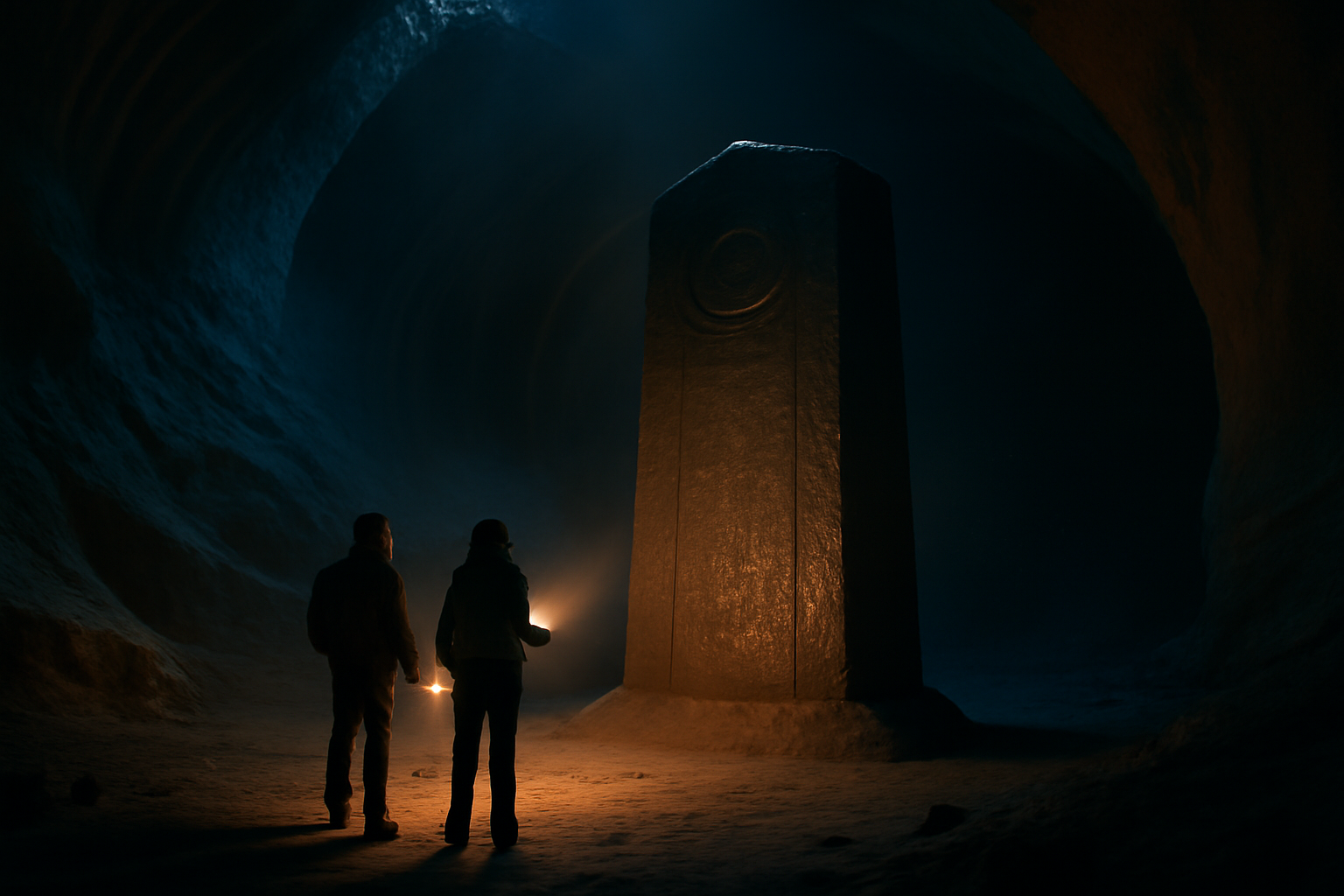
The roof arched above them like the inside of a colossal ribcage. Bands of stone curved in perfect parallel arcs overhead, meeting in a single point at the peak.
“Sara,” he whispered, “this isn’t a cave.”
“No,” she murmured. “It’s engineered.”
The floor was flat — impossibly flat — like a platform.
He shone his light across the room and felt his breath catch.
At the center sat a stone monolith, three meters tall, smooth as obsidian. Every surface was covered in the same strange symbols — more elaborate now, spiraling inward toward a circular indentation at its core.
Sara approached first. “It looks like—”
“A seal,” Aiden finished.
She frowned. “What kind?”
“The kind meant to stay closed.”
He circled the monolith slowly. The hair on his arms stood up, though the air was warm and still. At the base, the stone was fused seamlessly with the platform, as though carved from a single massive slab.
And on the ground near the base—
Aiden’s pulse stopped.
Boot prints.
Someone had been here.
But the prints were old. Very old. Edges softened by time, the dust inside packed and settled. At least fifty years, maybe more. But they did not match any documented expedition.
Sara knelt beside them. “Aiden… these belong to only one person.”
He didn’t want her to say it.
“Your father.”
His teeth clenched. The air wavered around him.
“My father disappeared in Patagonia,” he said stiffly. “We never found his body.”
“What if he didn’t disappear?” Sara whispered. “What if he came here? What if this is where he—”
A tremor rippled through the chamber.
The monolith’s symbols pulsed.
Once.
Again.
Stronger.
The floor beneath them vibrated. Dust drifted from the ceiling. A deep, resonant hum filled the air, vibrating through their bones.
Sara staggered. “We triggered something—”
“No,” Aiden said, eyes fixed on the monolith. “Someone else did.”
The indentation at its center glowed faintly. A shape appeared inside the stone — circular, metallic, swirling faintly like liquid metal trapped in solid rock.
“What is that?” Sara breathed.
Aiden stepped closer.
“It’s a lock.”
The liquid-metal shape pulsed, matching the rhythm of his heartbeat. His hand tingled. His chest tightened.
Sara grabbed his arm. “Aiden. Don’t.”
But something under his skin burned. Familiar. Wrong. Ancient.
His father’s pocket watch — still in his jacket — vibrated violently.
The monolith hummed louder, symbols rippling outward like waves.
“Aiden,” Sara shouted, “we have to go!”
The lock dilated — opening like an iris.
Aiden’s breath hitched.
Behind it was… not stone. Not metal. Not any material on Earth.
Behind it was depth.
Impossible, infinite depth.
Not a chamber.
Not a tunnel.
A threshold.
“Aiden—” Sara screamed.
The lock opened.
The chamber exploded with light.
Not white.
Not natural.
A light like memory made physical — old, heavy, intelligent.
For one instant, Aiden saw something on the other side. A world that did not belong beneath mountains. Towers of light. Moving shadows. Something alive that recognized him.
He stumbled backward.
The light snapped off.
Silence swallowed the chamber.
The monolith sealed itself — the lock melting back into the stone as if it had never opened.
Sara’s voice trembled. “What… what did you see?”
Aiden stared at the monolith, heart pounding in terrified recognition.
“I saw my father.”